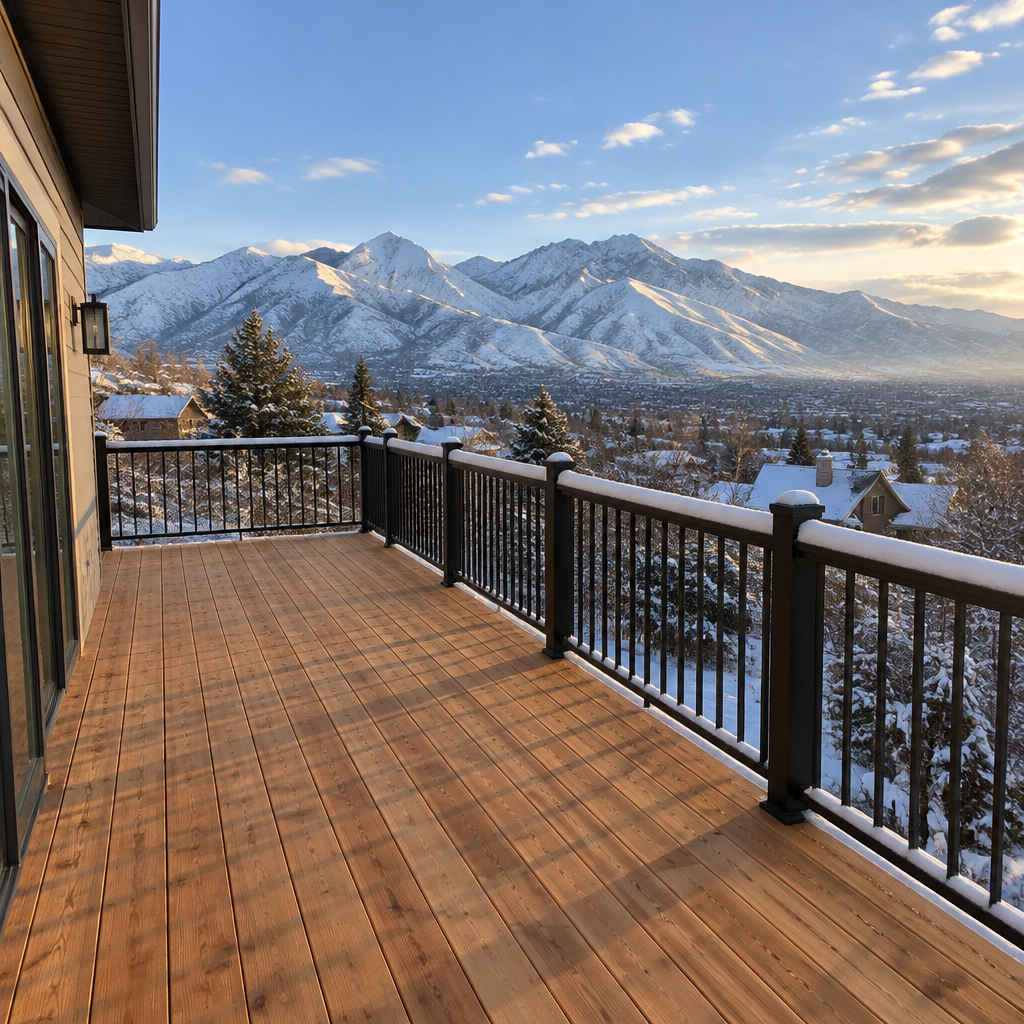
Decks in this valley are structural in a way Portland decks often are not. Snow sits on them, the ground under the footings freezes, and the sun at 4,300 feet takes a finish apart faster than anything on the coast.
The failure we see most is not a rotten board or a wobbly railing. It is a deck that was framed for people and then spent fifteen winters holding snow.
Three things follow from that. Joist spans have to assume a load the original builder may not have planned for. The ledger, which is where a deck attaches to the house, has to be flashed and counter-flashed properly, because snow melt running down the wall finds that joint every spring. And posts need to be sized and spaced for the actual span rather than copied from a coastal detail. When we open a ledger and find the band joist behind it is soft, that is a framing repair, not a flashing repair, and we price it that way after showing you a photo.
Ground that freezes lifts things. Footings that stop above the frost line heave, and a heaved footing shows up first as a high spot in the deck surface, then as a gate that will not latch, then as a cracked post base. We dig to depth, and we do not reuse an old pier because it happens to be in roughly the right place.
The same mechanism ruins fences. A gate that drags every February and frees itself every May is telling you the post footing is too shallow, and shimming the hinge only hides it for one season.
UV at this elevation is roughly ten percent stronger than at sea level, and it is relentless because there is very little cloud cover for eight months of the year. Composite boards fade and chalk noticeably sooner here than the manufacturer's coast-based photography suggests. Cedar goes silver within a season unless it is sealed, and then needs re-sealing on a shorter cycle than the label claims. Horizontal surfaces take the worst of it: handrails, caps and stair treads.
Practically: pick materials for sun exposure first and appearance second, and budget for recoating. A finish that is right in Portland is often too light for a south-facing deck in Sandy.
Repair usually wins when the frame and footings are sound and the problems are surface: worn boards, a failed rail, loose stairs, a flashing detail that was wrong from day one. Replace when the ledger or the band joist is soft, when posts are undersized for snow, when footings have heaved, or when more than about a third of the decking is gone. We will tell you which one you are looking at in person, and we will not sell a rebuild for a flashing problem.
Cedar is the local default and it works, with a shorter lifespan on the sunny side of the yard. Vinyl holds colour but goes brittle in cold, and a vinyl panel hit by a snow slide usually cracks rather than bends. Metal is the longest-lived and the most expensive. Whatever the material, the two details that decide how long it lasts are post depth and how the panel is fixed, not the board itself.
Wind across the valley floor also matters. A solid six-foot run on an exposed corner in West Valley acts as a sail, and posts set for a sheltered lot will lean within a few seasons. On exposed lots we space and brace differently.
Deck permits are issued by whichever city the address sits in, and again that is not one authority. Salt Lake City reviews deck applications through its Citizen Access Portal, with plan review before the permit issues and inspections scheduled against the permit number. Millcreek, Holladay, Cottonwood Heights, Sandy, South Salt Lake and West Valley each run their own building department, with their own review times.
Height, setback and lot coverage rules also vary by city, and newer subdivisions in Herriman, Riverton, South Jordan and Daybreak layer HOA approval on top of the city permit. We ask for the HOA design guidelines at the estimate stage, because the fastest way to lose a month is to build a fence the architectural committee then rejects.
Oregon work is covered by our CCB licence, #228535. Utah licenses contractors through the Department of Professional Licensing (DOPL) instead, with separate general and specialty classifications and a dollar threshold above which a licence is required. A deck or a long fence run is exactly the kind of project where that threshold decides whether a licence is required at all, so we check it against your scope rather than assume. Utah and Oregon are not interchangeable, and we will not pretend otherwise. Every Salt Lake estimate names the licence and the permit path that apply to your address, in writing, before work starts.
Nothing here is priced from a photo or a phone call, because footing depth and the condition of the band joist behind the ledger are what decide the number, and neither is visible until someone is standing on it. Every deck and fence project starts with a free on-site walkthrough, and the written estimate follows, with materials and labour separated so a second bid can be compared line by line.
Salt Lake City proper, the Avenues, Sugar House, Liberty Wells, Rose Park, Glendale, the East Bench, and out through Millcreek, Holladay, Cottonwood Heights, Murray, South Salt Lake, West Valley City, Taylorsville, Sandy, Draper, Riverton, Herriman and South Jordan.
Free on-site estimate: call (503) 868-2477 or request a walkthrough.
KS & Son Construction LLC · 804 SE 139th Ave, Portland, OR 97233 · (503) 868-2477